
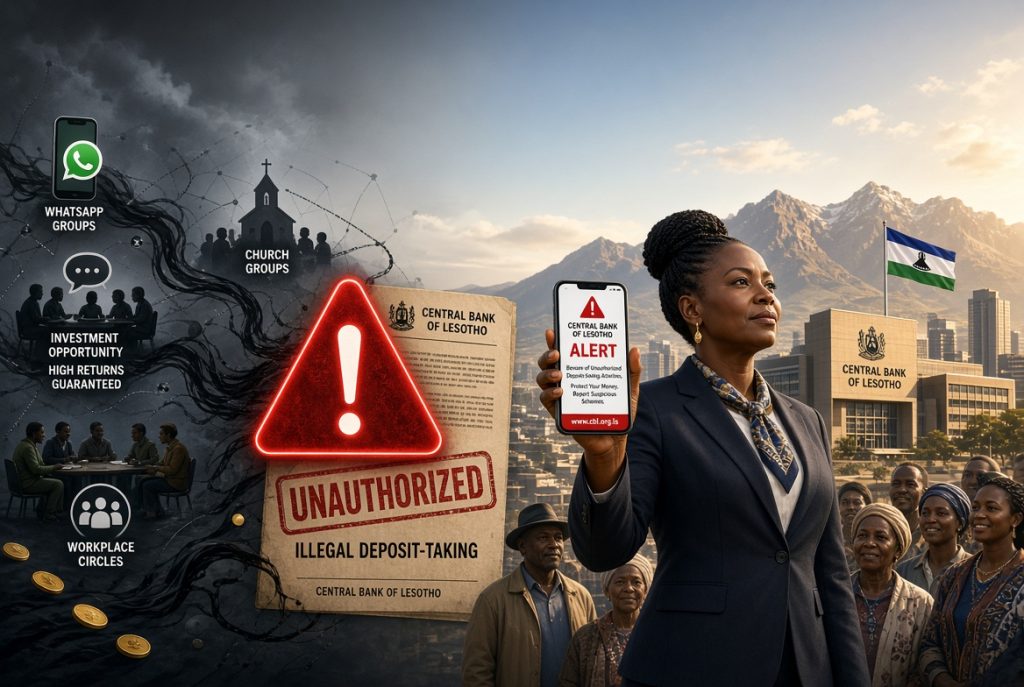
When the Regulator Speaks – Decoding the Central Bank of Lesotho’s Warnings
Target Audience: Community leaders, church groups, workplace supervisors, and everyone trying to understand the legal reality behind rogue financial platforms in Lesotho.
When the Central Bank of Lesotho (CBL) issues a public warning regarding illegal financial operations, it isn’t just routine paperwork, it is a critical fire alarm for the public.
Regulators have recently flagged specific online and community-based platforms for soliciting deposits from the public without a valid license.
Why do these specific warnings matter, and what does the law actually say about operating or participating in these schemes in Lesotho? Let’s break it down.
1. Why a License is Non-Negotiable
Under Lesotho’s Financial Institutions Act, taking deposits or soliciting investments from the general public is strictly reserved for authorized, licensed institutions (such as registered commercial banks and microfinance entities).
- A platform that invites you to “invest” money with a promise of quick, guaranteed returns is legally conducting deposit-taking.
- If they do not hold a direct, verifiable license from the CBL, their entire operation is illegal from the moment they accept their first loti regardless of whether early participants claim they were paid.
2. Incorporation is Not a Shield
Many fraudulent promoters try to gain trust by registering a local company or using fancy corporate terminology. However, under local financial laws:
- Incorporation shell companies do not bypass the need for a specific CBL financial license.
- Directors, local coordinators, and individuals running these local fronts face severe personal, civil, and criminal liability. When an offshore or anonymous platform crashes, the anonymous masterminds vanish, but the local “team leaders” and recruiters are left.
3. The Danger to Workplaces, Churches, and Burial Societies
Illegal schemes do not advertise on billboards; instead, they creep into trusted community networks like workplace WhatsApp groups, church congregations, and local burial societies.
The Risk of Group Funds: Fraudsters love targeting pooled community savings because it scales up their cash flow quickly.
Institutional Liability: Group leaders need to be vigilant. If an individual uses the apparent authority of a church group or workplace collective to recruit members into an unauthorized scheme, the entire institution risks reputational damage, fractured relationships, and severe financial ruin if group funds are mishandled.
What is the Bottom Line?
The Central Bank, alongside regulatory bodies like the Financial Intelligence Unit (FIU), continuously tracks suspicious money flows and issues alerts to shield citizens.
Before you put your money anywhere:
- Demand proof of a valid CBL license.
- Verify independently by contacting the Central Bank directly rather than trusting screenshots or documents supplied by the recruiter.
- Remember: If it sounds too good to be true, it’s not just a gamble under Lesotho law, it is an unauthorized and dangerous trap.
Share this post to keep your community informed and safe from unregulated financial schemes.