
Why the US-Iran Conflict Matters to Every Mosotho Household
As of March 2026, the ‘distant war’ has officially arrived at our doorsteps. While we saw a small fuel price adjustment on March 4, this was only the quiet before the storm. Because of the heavy fighting in the Middle East over the last week, oil prices have exploded, and experts are now predicting a massive price shock on April 1st. For every Mosotho household, this isn’t just news it is a countdown. If we do not act in the next 21 days, the cost of transport and basic food will move beyond the reach of many.
Many Basotho look at the news of ‘Operation Epic Fury’ and rising tensions between the United States and Iran and think it is thousands of kilometers away, wondering, ‘How does it affect me in Quthing, Mokhotlong, or Maseru?’ The uncomfortable truth is that the world is connected by a single pipe called The Oil Pipe. When the Middle East shakes, the price of life in Lesotho rises. We are already seeing fuel prices in Southern Africa jump, and this is only the beginning.
Why This Hits Your Pocket Directly
Lesotho imports almost all its refined fuel and consumer goods from South Africa. When global oil prices spike:
- Transport Costs Skyrocket:Taxis and buses will definately raise fares to survive.
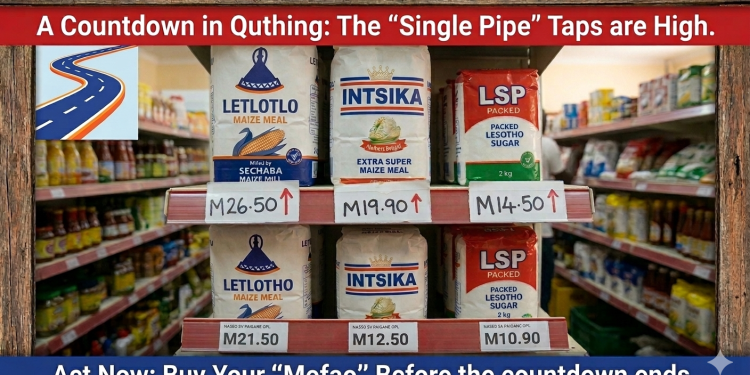
- Food Becomes a Luxury:Every bag of maize meal is brought to your local shop by a truck. If the truck’s diesel costs more, your papa costs more.
- The ‘Ripple Effect’:Small businesses from hair salons using geysers to farmers using tractors are forced to raise prices just to stay operating.
5 Practical Steps to Protect Your Family Today
i. Secure Your “Mofao” (The Emergency Shield)
In our culture, mofao is the food or provision we take for a journey. Our journey is through an economic storm.
Action: Stop all ‘luxury’ spending immediately.
The Goal: Save even M20 a week. Call it ‘Chelete ea Matsatsi a thata’ (Money for the difficult times). This is a shield against anticipated high jump in taxi fares or food prices.
ii. Practice “Ho Boloka” (Strategic Stockpiling)
Prices today are likely to be the lowest they will be for the next six months.
Action: When you get your next salary or piece-job pay, buy one extra packet of soap, a bottle of oil, or sugar.
Why: You aren’t just buying food; you are “locking in” today’s price before it goes up next month.
iii. Review Your Movement
Every kilometer traveled will be more expensive.
Action: Start planning your trips. If you live in the villages and need to go to town, do everything in one trip. If you live in Maseru, consider walking short distances.
Community Tip: Talk to neighbors about sharing a taxi or “carpooling” to work towards splitting the cost.
iv. Beware of ‘baqhekanyetsi’ (Fast Money Scams)
When times get tough, scammers get busy. They will promise you “Forex wealth” or “Bitcoin miracles” to help you survive the inflation.
The Rule: If a deal sounds like a miracle, it’s a trap. Protect the little you have; do not gamble it away in desperation.
v. Revive the Spirit of ‘Letsema’
Basotho have survived droughts and wars because working together.
Action: Buy groceries in bulk as a group (society) to get wholesale prices. Share a garden/field. Check on your elderly neighbors and love them dearly ‘Ha ba loee ba hulile’ (They are simply old people, not witches).
The Wisdom: A single stick is easily broken, but a bundle of sticks (ngata) is unbreakable.
The Bottom Line
We cannot stop the drones or the missiles in the Middle East. But we can control how prepared our homes are. The “Wise Mosotho” does not wait for the shopkeeper to change the price tag to start saving, they start today and now.
Prepare now, so your family can sleep in peace tomorrow.